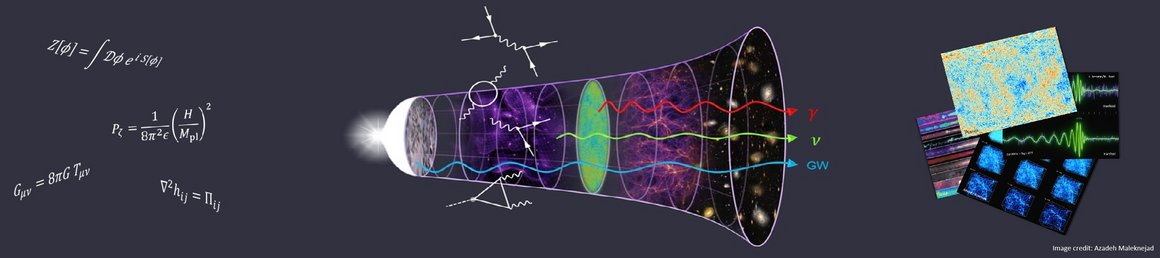
Cosmology has entered an era of remarkable precision, fueled by the wealth of data already in hand from the cosmic microwave background (CMB), large-scale structure (LSS), and gravitational-wave (GW) detections. This precision will only deepen over the next decade as upcoming surveys and detectors deliver an unprecedented breadth and depth of observations.
The common key questions of cosmology and particle physics are the source of observed matter asymmetry in the Universe that led to the formation of LSS, the particle nature of dark matter and its production mechanism, and the particle physics of cosmic inflation. To address these questions, we rely on physics beyond the Standard Model of particle physics. Recent experimental advances have opened a new window of opportunity for cosmology and astrophysics to probe the sky as a free particle collider, shedding light on new physics beyond the reach of particle colliders on Earth.
To fully exploit the upcoming data, this precision must be matched with deeper theoretical insight and advanced numerical methods, enabling us to probe particle production processes in the very early Universe and uncover their role in shaping the formation of our cosmos.
This workshop will bring together experts spanning theoretical cosmology, particle physics, phenomenology, observational and experimental probes, nonlinear dynamics, and lattice simulations. By fostering exchange across these approaches, the program will consolidate recent progress, keep the community connected, and help shape future directions in this rapidly evolving field.
Week 1: Theory and Phenomenology (baryogenesis, dark matter, primordial black holes)
Week 2: Numerical Techniques and Simulations
Week 3: Topical Workshop + Focused Panels (register here)
Week 4: Observational and Experimental Probes (gravitational waves, neutrinos, primordial magnetic fields, multi-messengers)