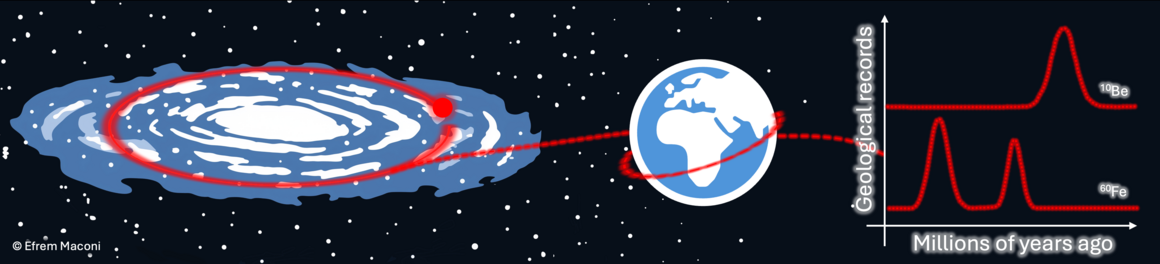
As Earth orbits the Sun, the Solar System itself orbits the center of the Milky Way, carrying us through a continuously changing Galactic environment. Encounters with dense gas structures, such as molecular clouds and supernova shock fronts, may leave measurable imprints on the Solar System. An enhanced influx of interstellar dust into the Solar System, and Earth's atmosphere, could deposit radionuclide anomalies in terrestrial archives. Nearby supernovae may produce similar signals by raising the cosmic-ray flux. And if the ambient gas density is high enough, the heliosphere itself can be compressed, potentially exposing parts of the Solar System directly to the interstellar medium.
Recent advances in astronomy, geochemistry, and paleoclimatology make this a timely question. In astronomy, ESA's Gaia mission has transformed our view of the local Galactic environment, revealing large-scale gas structures and stellar clusters that were previously unknown and allowing them to be placed along the Solar System's past trajectory. In geochemistry, better analytical techniques and growing datasets have uncovered anomalies in radionuclide and interplanetary dust records, some already tied to astrophysical events, others still unexplained. In paleoclimatology, new high-resolution proxy records and Earth system model simulations of past climates are becoming available. Together, these developments open a new window on the connections between the Galactic, Solar, and terrestrial environments.
This meeting aims to characterize the past and future Galactic environments encountered by the Solar System, to test possible links between those environments and changes in the Earth system, to constrain the conditions under which interstellar densities and close supernovae can produce radionuclide anomalies or enhanced extraterrestrial particle fluxes, and to build lasting collaboration across astronomy, geology, and paleoclimatology.
Topics of particular interest include:
Astronomy:
Geology & Geochemistry
Paleoclimate
The program will open with a topical workshop. Below is a short description. More information will be available soon.
TOPICAL WORKSHOP (Week 1): From the Milky Way to Earth’s Archives: Bridging Communities
In this three-day focus meeting we aim to establish a common framework across astronomy, geosciences, paleoclimatology, and related fields, and to initiate the collaborative work for the remainder of the workshop. The meeting will bring together perspectives on the Galactic environment and relevant astrophysical processes, including supernovae, cosmic rays, heliosphere studies, and the transport of dust and radionuclides, with expertise on terrestrial archives, radionuclide detection techniques, paleoclimate records, and climate modelling. Particular emphasis will be placed on the current uncertainties, assumptions, time resolution issues, and terminologies explicit across the different fields. With this, we aim to identify what is actually observable, which processes could mimic a proposed signal, which uncertainties dominate, and what kind of observations, datasets, or models could discriminate between competing explanations. Thus, the goal is to identify the most important open questions and translate them into concrete opportunities for collaboration, including shared datasets, modeling needs, and feasible cross-disciplinary projects that can be pursued during the remainder of the month.